
Earthing Rod
Earthing Rod Manufacturer
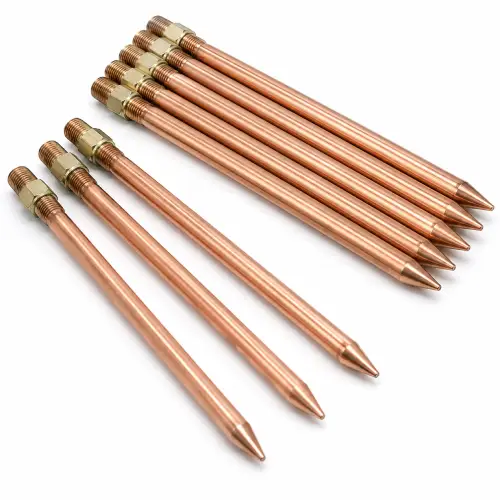
Industrial Electric is a dependable Earthing Rod Manufacturer and Supplier serving electrical contractors, industrial buyers, EPC companies, infrastructure developers, construction firms, and project procurement teams. Earthing rods are an important part of a grounding arrangement, providing a conductive electrode that transfers fault current safely into the surrounding earth when incorporated into a properly engineered earthing system.
Understanding the Product
An Earthing Rod is a conductive electrode installed into the ground and connected to an electrical installation through an appropriate earthing conductor. The rod provides a defined path between the electrical system and the earth.
Its effectiveness is influenced by the complete installation rather than the rod alone. Factors such as soil resistivity, installation depth, moisture, electrode dimensions, connection quality, conductor selection, and surrounding ground conditions can affect the performance of the grounding system.
About Industrial Electric
At Industrial Electric, we supply earthing rods for a wide range of electrical and grounding requirements. We understand that different sites have different soil conditions and engineering requirements, so product selection should be based on the actual application rather than simply choosing a standard product.
Our customers include:
- Electrical contractors
- EPC companies
- Industrial plants
- Construction companies
- Solar project developers
- Infrastructure companies
- Electrical installation professionals
- Project procurement teams
How an Earthing Rod Supports Electrical Safety
During an electrical fault, unwanted current needs a controlled route back toward the electrical source so that protective equipment can operate appropriately. An earthing rod forms part of this overall grounding path by providing an electrode-to-earth connection.
A correctly designed grounding system can help with:
- Electrical fault-current dissipation
- Equipment grounding
- Electrical bonding
- Protection of electrical installations
- Reduction of dangerous touch voltages
- Reliable operation of protective devices
- Grounding of structures and equipment
The complete system should always be designed and installed according to applicable electrical requirements by qualified professionals.
Manufacturing & Quality Considerations
Manufacturing an earthing rod requires attention to dimensional accuracy, material consistency, surface condition, and mechanical integrity.
A typical production workflow may include:
- Material Preparation:
- Forming & Machining:
- Surface Treatment:
- Dimensional Inspection:
- Finishing & Packing:
Actual manufacturing processes and specifications depend on the product design and applicable standards.
Key Features of a Reliable Earthing Rod
A suitable earthing rod should offer characteristics appropriate to its intended installation, such as:
- Adequate mechanical strength
- Consistent dimensions
- Good electrical conductivity
- Suitable resistance to environmental exposure
- Proper surface finish
- Compatibility with the selected earthing conductor
- Reliable connection arrangements
- Suitability for the site and soil conditions
Performance Specifications
The following parameters should be considered when specifying an earthing rod:
|
Parameter |
Requirement |
|
Product |
Earthing Rod |
|
Material |
As specified for the project |
|
Rod Diameter |
According to design |
|
Rod Length |
According to installation requirement |
|
Surface Finish |
As specified |
|
Connection |
Compatible with earthing conductor |
|
Installation |
Ground-installed electrode |
|
Application |
Electrical grounding |
|
Environment |
Selected according to site conditions |
For large or critical projects, the required material, dimensions, coating, and applicable standards should be confirmed before procurement.
What Determines Earthing Rod Performance?
The performance of an earthing rod is strongly connected to the conditions in which it is installed.
- Soil Resistivity
Different soils provide different levels of electrical resistance. Soil testing can help determine whether the selected electrode arrangement is appropriate.
- Installation Depth
The depth of the electrode can influence its contact with the surrounding soil and should be determined as part of the grounding design.
- Moisture Conditions
Soil moisture can affect electrical conductivity. Seasonal variations may therefore need to be considered for certain installations.
- Connection Quality
A secure connection between the rod and earthing conductor is essential for maintaining continuity throughout the grounding path.
- Corrosion Environment
Soil chemistry and environmental exposure can influence the long-term condition of an electrode. Appropriate material and surface protection should therefore be selected for the site.
Where Earthing Rods Are Used
Earthing rods can be incorporated into grounding systems for:
- Industrial Plants
For grounding machinery, electrical panels, transformers, generators, and other equipment.
- Commercial Buildings
Used as part of grounding arrangements for electrical installations in offices, warehouses, malls, and commercial properties.
- Solar Power Projects
Can be incorporated into grounding systems for solar structures, inverters, panels, and associated electrical equipment according to project design.
- Telecommunication Facilities
Suitable for grounding communication equipment and supporting infrastructure where specified.
- Electrical Substations
Can form part of grounding arrangements for electrical equipment and structures.
- Residential Construction
Used in suitable building earthing systems where an electrode-based grounding arrangement is specified.
- Infrastructure Projects
Applicable to various electrical installations associated with factories, utilities, transportation facilities, and other infrastructure.
Installation Considerations
Proper installation is just as important as product quality. Before installing an earthing rod, project engineers or qualified electricians should consider:
- Soil characteristics
- Required earth resistance
- Electrode location
- Installation depth
- Conductor size
- Connection method
- Corrosion conditions
- Accessibility for inspection and testing
- Applicable electrical regulations and standards
After installation, the grounding system should be tested using appropriate procedures to verify its performance.
Why Industrial Electric?
Industrial Electric focuses on supplying earthing products based on application requirements rather than simply offering a generic product. We understand that an earthing rod for a solar project may have different requirements from one intended for an industrial plant or commercial building.
Our Key Advantages
- Application-oriented product guidance
- Attention to product dimensions and specifications
- Suitable for industrial and commercial requirements
- Support for project and bulk quantities
- Reliable procurement assistance
- Suitable for contractors, EPC companies and industries
- Focus on consistent product quality
- Support from enquiry through supply
Earthing Rod Manufacturer for Project Requirements
Industrial Electric supplies earthing rods for electrical grounding projects ranging from individual installations to larger industrial and infrastructure requirements. Customers can share their required diameter, length, material specification, quantity, application, and project location to identify the appropriate product.
We aim to make procurement easier by understanding the actual grounding requirement before recommending the suitable specification.
