
Copper Earthing Material
Copper Earthing Material Manufacturer
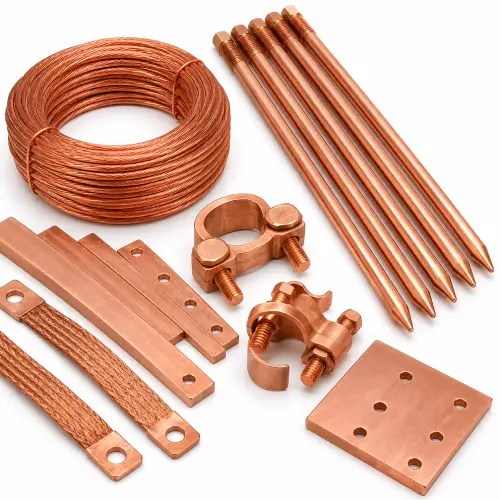
Industrial Electric is a reliable Copper Earthing Material Manufacturer in Kolkata, West Bengal, Bihar, Jharkhand, Chhattisgarh, and Assam providing copper-based grounding components for electrical, industrial, commercial, infrastructure, solar, and power distribution projects. Copper is widely selected for earthing applications because of its excellent electrical conductivity and suitability for installations where dependable current transfer and long-term performance are important.
Understanding Copper Earthing Material
Copper Earthing Material forms part of an electrical grounding and bonding system designed to provide a controlled path for fault current and help maintain electrical safety. Depending on the project design, copper components can be used for connecting electrical equipment, earth electrodes, structures, panels, busbars, and other grounding points.
The appropriate copper component should be selected according to current-carrying requirements, conductor dimensions, connection arrangement, installation environment, soil conditions, and applicable electrical standards.
About Industrial Electric
At Industrial Electric, we supply copper earthing products for electrical contractors, EPC companies, industries, builders, solar installers, infrastructure developers, and project procurement teams.
Our approach is focused on understanding the actual application before recommending a suitable product specification. Customers can discuss their required dimensions, material specifications, quantities, connection requirements, and project conditions with our team.
What Makes Copper Earthing Material Different?
Copper has a high level of electrical conductivity, making it an established material for many grounding and bonding applications. It also offers good resistance to corrosion in many environments, although the suitability of copper should always be assessed against the specific soil and installation conditions.
A properly selected Copper Earthing Component can provide:
- Efficient electrical conductivity
- Reliable grounding connections
- Good mechanical performance
- Long-term service potential
- Suitable resistance to many environmental conditions
- Compatibility with various electrical grounding arrangements
The performance of the complete system still depends on correct design, installation, connections, and site conditions.
Manufacturing & Quality Process
The manufacturing process varies according to the specific Copper Earthing Product, but quality control generally begins with appropriate copper material selection and continues through forming, machining, finishing, and inspection.
- Material Selection
Copper of the required grade and conductivity characteristics is selected according to the intended application.
- Forming & Fabrication
The material is processed into the required shape and dimensions using suitable manufacturing methods.
- Machining
Where required, holes, slots, bends, terminals, or other connection features are produced according to the specified design.
- Surface Finishing
The finished component is processed to achieve the required surface condition and dimensional accuracy.
- Inspection
Products are checked for relevant parameters such as dimensions, surface finish, workmanship, and overall product consistency.
- Packing & Dispatch
Finished products are packed appropriately to protect them during storage, handling, and transportation.
Key Reasons to Choose Copper Earthing Material
- High electrical conductivity
- Reliable grounding and bonding performance
- Suitable for various electrical installations
- Good mechanical strength in appropriately designed products
- Suitable for industrial and commercial applications
- Useful for high-performance grounding arrangements
- Available according to project requirements
- Suitable for customized dimensions where applicable
- Convenient for professional electrical installations
- Appropriate for long-term grounding applications when correctly selected
Performance Specifications
Copper Earthing products should be selected according to the requirements of the electrical system.
Parameter | Specification / Consideration |
Product | Copper Earthing Material |
Primary Material | Copper |
Electrical Property | High conductivity |
Dimensions | According to application |
Thickness / Diameter | As required |
Connection Arrangement | As specified |
Surface Finish | According to product design |
Application | Earthing and bonding |
Installation | Indoor / outdoor / underground as applicable |
Environment | Based on site conditions |
Exact dimensions, copper grade, conductivity, and other technical parameters should be confirmed from the product specification before procurement.
Where Copper Earthing Material Is Used
- Electrical Substations
Copper grounding components can be incorporated into equipment grounding, bonding, and substation earthing arrangements where specified.
- Industrial Plants
Suitable for grounding electrical panels, machinery, transformers, generators, and other industrial equipment.
- Data Centres
Copper is often considered for grounding and bonding applications where reliable electrical connections are important.
- Solar Power Plants
Copper earthing components can be used for grounding electrical equipment, structures, inverter systems, and associated installations according to the project design.
- Commercial Buildings
Useful for grounding electrical installations in offices, commercial complexes, warehouses, institutions, and other facilities.
- Power Distribution Systems
Copper components can be incorporated into grounding and bonding arrangements around distribution equipment and electrical infrastructure.
- Telecommunication Facilities
Suitable for grounding communication and electrical equipment where the project specification calls for copper conductors or components.
Factors to Consider Before Selecting Copper Earthing Material
Selecting copper simply because of its conductivity is not enough. The complete installation should be evaluated.
Important considerations include:
- Required fault-current capacity
- Copper grade and conductivity
- Conductor dimensions
- Connection type
- Soil chemistry
- Moisture conditions
- Corrosion environment
- Compatibility with other metals
- Installation method
- Applicable electrical standards
- Required earth resistance
Special attention should be given to connections between dissimilar metals because unsuitable combinations can create corrosion-related issues under certain environmental conditions.
Installation Considerations
The copper earthing component should be installed according to the approved electrical design and manufacturer’s recommendations.
Depending on the product, installation may involve:
- Preparing the connection or installation point.
- Positioning the copper component correctly.
- Making a secure mechanical or approved electrical connection.
- Ensuring proper continuity throughout the grounding path.
- Protecting connections where required.
- Providing suitable inspection access.
- Testing the completed earthing system.
Installation and testing should be performed by qualified electrical professionals.
Why Choose Industrial Electric?
Industrial Electric focuses on supplying earthing products based on actual application requirements rather than generic product selection. We understand that grounding requirements can vary significantly between a solar plant, manufacturing unit, commercial building, substation, and data facility.
Our Advantages
- Application-oriented product guidance
- Copper earthing solutions for different requirements
- Support for bulk and project orders
- Attention to dimensions and specifications
- Suitable for industrial and commercial applications
- Support for EPC companies and electrical contractors
- Reliable procurement assistance
- Focus on consistent product quality
- Project-specific supply support
Copper Earthing Material Manufacturer in India
Industrial Electric supplies Copper Earthing Material for customers involved in electrical construction, industrial projects, solar installations, substations, commercial developments, infrastructure, and power distribution in Kolkata, West Bengal, Bihar, Jharkhand, Chhattisgarh, and Assam.
Customers can share their required product specification, dimensions, material grade, quantity, application, and project location to discuss the most appropriate copper earthing solution.
Frequently Asked Questions
Copper has excellent electrical conductivity, making it suitable for many grounding and bonding applications where efficient current transfer is required.
It can be used in industrial plants, substations, solar projects, commercial buildings, data centres, telecom facilities, and power distribution installations.
Selection depends on the electrical requirements, conductor dimensions, connection arrangement, environment, soil conditions, applicable standards, and overall grounding design.
Connections between dissimilar metals need to be properly designed because environmental conditions can contribute to galvanic corrosion. Suitable connectors and installation practices should be used where required.
